Document Object Model (DOM)

DOM
The DOM (Document Object Model) is a programming interface for HTML and XML documents. It represents the structure of a web page as a hierarchical tree of objects, where each object corresponds to an element, attribute, or text node in the document.
The DOM provides a way for web developers to access and manipulate the content and structure of a web page using JavaScript. With the DOM, you can add, remove, and modify elements and attributes on the page dynamically, without needing to reload the entire page.
The DOM tree consists of various types of nodes, including:
Element nodes: Represent HTML elements, such as
<div>,<p>, or<img>.Attribute nodes: Represent attributes of an element, such as
srcorhref.Text nodes: Represent the text content of an element.
Comment nodes: Represent HTML comments, such as
<!-- this is a comment -->.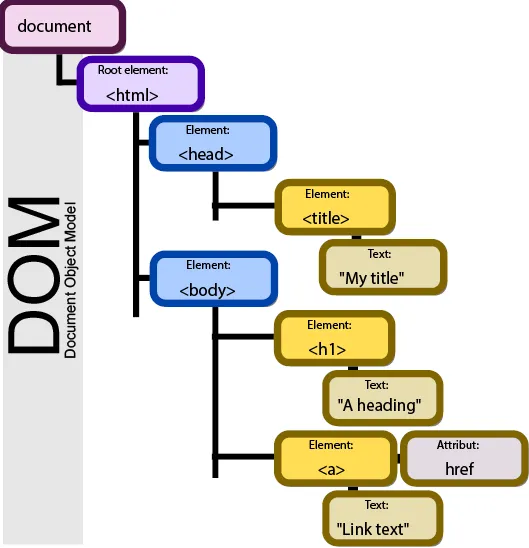
Each node in the DOM tree is an object with properties and methods that you can use to interact with it. For example, you can use the querySelector() method to select an element, and then use the innerHTML property to change its content.
Here's an example of how to use the DOM to add a new element to a web page:
<!-- HTML -->
<div id="myDiv">This is my div.</div>
// JavaScript
const myDiv = document.getElementById('myDiv');
const newElement = document.createElement('p');
newElement.textContent = 'This is my new paragraph.';
myDiv.appendChild(newElement);
In this example, we use the document.getElementById() method to select the existing <div> element with the ID "myDiv". We then create a new <p> element using the document.createElement() method, set its text content using the textContent property, and add it to the <div> element using the appendChild() method. This adds the new paragraph as a child of the <div> element in the DOM tree, and it will be displayed on the web page when it is rendered.
Virtual DOM
The Virtual DOM (Virtual Document Object Model) is an abstract representation of the actual DOM (Document Object Model) that is managed by React, a popular JavaScript library for building user interfaces. The Virtual DOM was developed by React to optimize the process of updating the actual DOM, which can be slow and resource-intensive.
When a component in a React application is updated, React generates a new Virtual DOM tree by comparing the current Virtual DOM tree to the updated state of the component. React then calculates the minimum number of changes required to update the actual DOM to reflect the updated state of the component. Once these changes are calculated, React applies the changes to the actual DOM in a process known as reconciliation.
The Virtual DOM is lightweight and efficient because it only contains the necessary information to describe the structure and content of the actual DOM. Because it is managed entirely by React, it can be updated and manipulated more quickly than the actual DOM. By minimizing the number of changes required to update the actual DOM, React is able to optimize the performance of web applications and provide a smoother user experience.

Here are some benefits of using the Virtual DOM:
Improved performance: The Virtual DOM allows React to minimize the number of changes required to update the actual DOM, resulting in improved performance and a smoother user experience.
Efficient updates: Because the Virtual DOM is lightweight and managed entirely by React, updates and manipulations can be performed more quickly and efficiently than with the actual DOM.
Cross-platform compatibility: The Virtual DOM is a platform-agnostic representation of the actual DOM, which allows React to be used across a wide range of platforms and devices.
Ease of development: Because the Virtual DOM is managed by React, developers can focus on building and updating components without having to worry about the underlying DOM structure.
In summary, the Virtual DOM is an abstract representation of the actual DOM that is used by React to optimize the process of updating and manipulating the DOM. By minimizing the number of changes required to update the actual DOM, React improves the performance of web applications and provides a smoother user experience.
Difference between Real Dom and Virtual Dom
The main difference between the DOM (Document Object Model) and the Virtual DOM is that the DOM is a real-time, hierarchical tree structure that represents the actual HTML content of a web page, while the Virtual DOM is a lightweight copy of the actual DOM that React uses to efficiently update the HTML content.
The DOM is created by the browser when a web page loads, and it is a live, mutable representation of the page's HTML structure. It allows developers to access and manipulate the content and styles of a web page using JavaScript. When changes are made to the DOM, the browser re-renders the web page to reflect those changes.
On the other hand, the Virtual DOM is an abstract representation of the DOM that is managed entirely by React. When a component is updated in React, a new Virtual DOM tree is generated and compared to the previous Virtual DOM tree to identify the minimum number of changes required to update the actual DOM. Once the changes are identified, React updates the DOM efficiently, minimizing the amount of work required to update the page.
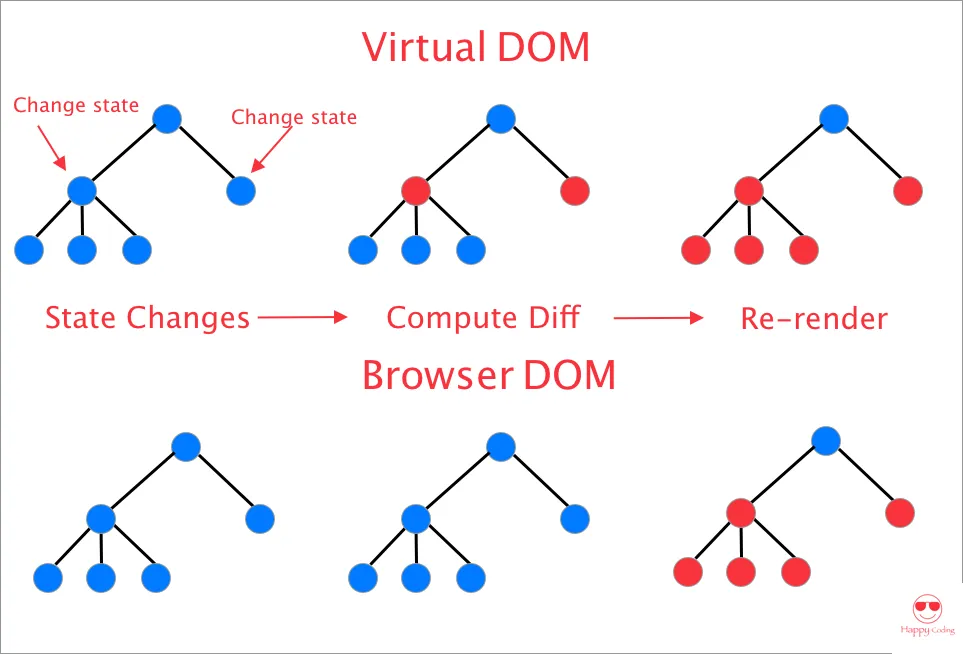
Here are some key differences between the DOM and the Virtual DOM:
Efficiency: The Virtual DOM is a lightweight representation of the actual DOM, which allows React to efficiently update the HTML content without requiring the browser to re-render the entire page.
Performance: The Virtual DOM allows React to minimize the number of changes required to update the actual DOM, resulting in improved performance.
Accessibility: The DOM can be accessed and manipulated using JavaScript, making it a powerful tool for developers. The Virtual DOM is managed entirely by React, and it is not directly accessible or manipulatable by developers.
Immutability: The Virtual DOM is immutable, which means that once it is created, it cannot be directly modified. Instead, any changes to the Virtual DOM result in the creation of a new Virtual DOM tree.
In summary, the DOM and the Virtual DOM both represent the structure and content of a web page, but they differ in how they are constructed, updated, and accessed. While the DOM is a live, hierarchical tree structure that represents the actual HTML content of a web page, the Virtual DOM is a lightweight, abstract copy of the actual DOM that is used by React to efficiently update the HTML content.